
Walking Backwards into the Future
Deep Time and the Work of Imagining the Future

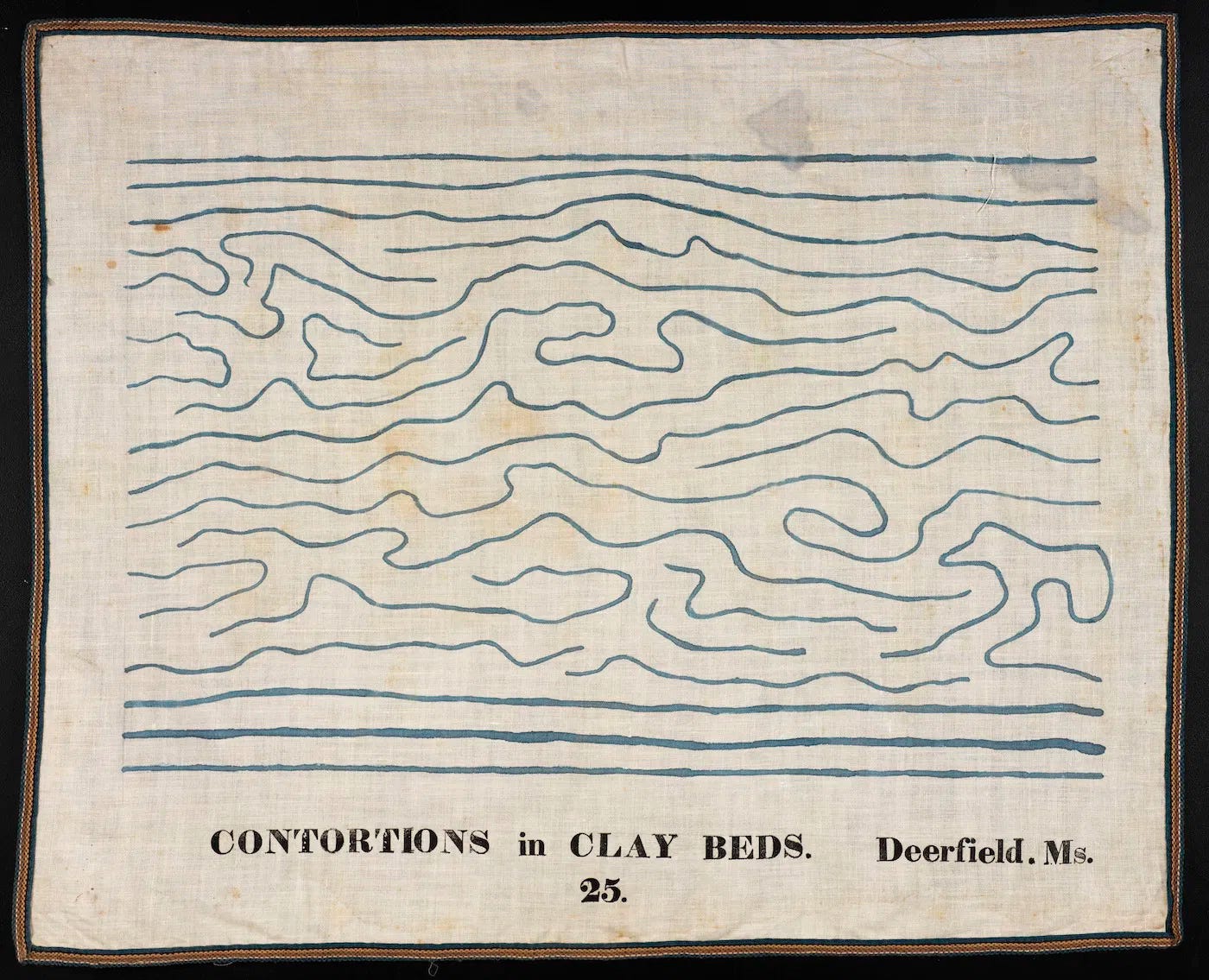
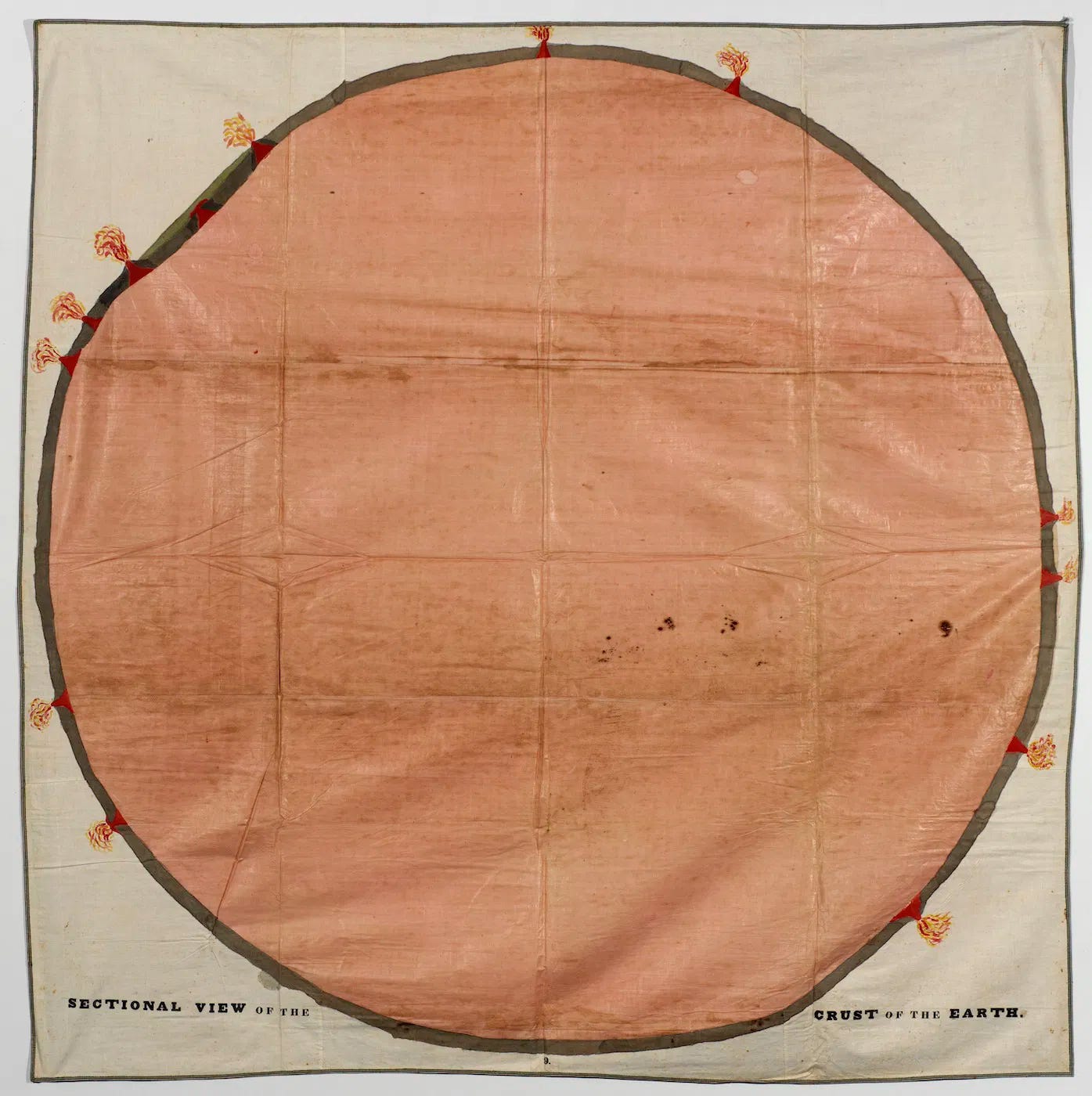
Heading north. Sun to my back. Layered up and a little too warm. Cars, buses and bikes rush past my shoulder. I steady my pace and start to peel back layers of the earth ahead of me. Asphalt curls back like the corner of a book page. Revealing a glowing geological cross section beneath.
Cables and pipes of plastic, terracotta and iron carry electricity, water, and human effluent through the soil like giant worms burrowing between buildings.
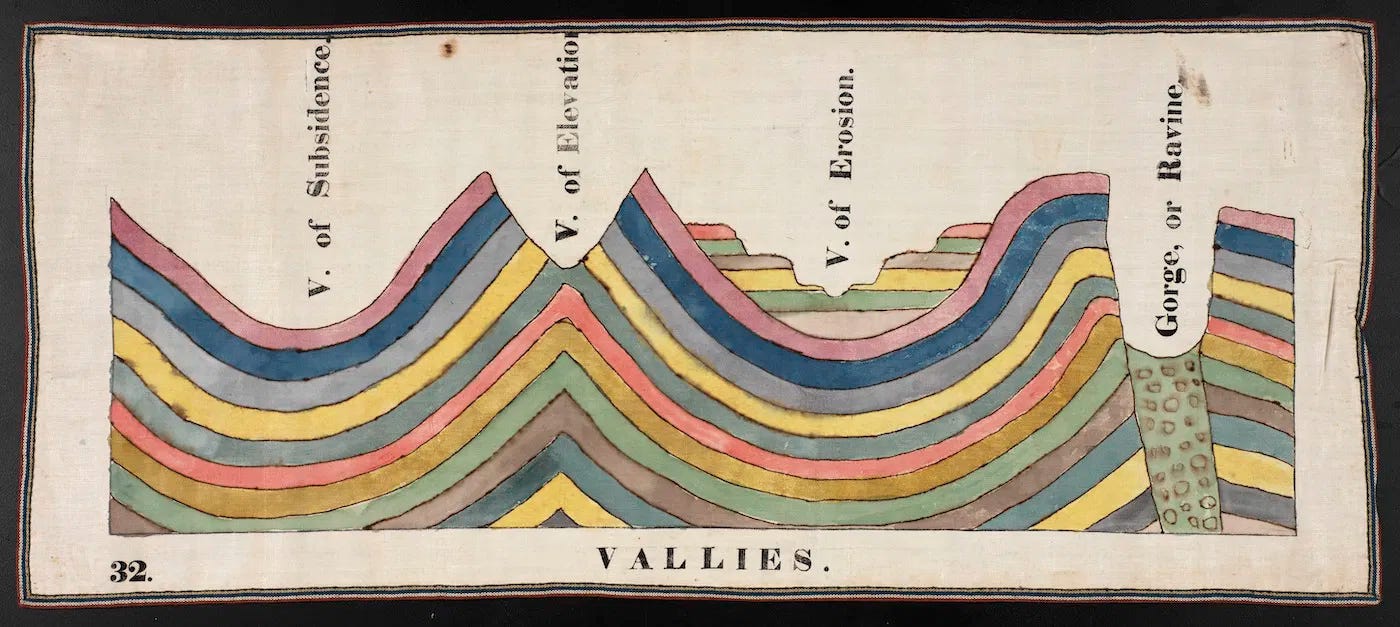
My mind digs deeper revealing the hidden stratum of this narrow ridge seven miles south of the Thames. A thin topping of gravel, chalk flints and pebbles, the signature of an ancient river that left long before humans made it this far north.
Deeper still the famous London clay. Sandier at first but then over a hundred meters of thick grey, busy with seeds heads and pods. Tiny ghosts of a fifty million year old tropical forest.
Wandering between pockets of woodland, here at the edges of London, I take part in this psycho-ecological play time. I observe stands of bracken unfurl to the height of oaks. I follow the rain drop on the brim of my cap as it flows back to when it was the tear of an early-human mother and before that, via a couple of ice ages, slurped from a leaf by Brachiosaur. I meet Ink Cap mushrooms whose ancestors turned the bones of my ancestors into soil.
I am part of this story. The deep past and the interdependence of the living present is all around me. Within me. This feels like the most true thing I’ve ever felt. Known.
This crack opened in my psyche when I did my first Deep Time Walk. An idea created by the late Dr Stephan Harding, an ecologist working with holistic science and Gaia theory. He died last year and I am grateful for his beautiful ideas and ongoing influence on me and so many others. His work translates complex systems into playful experiences. The Deep Time Walk is one of those translations: a 4.6 kilometre walk that takes you on a journey through the 4.6 billion year evolutionary history of Earth, each step carrying you across hundreds of thousands of years.
I walked it through city parks and scraps of woodland, listening to the script and soundscapes of the app version as I moved. The narration laid the long story of Earth over the short distances of my local landscape. I stood in a newly planted community orchard as the earliest life arrived in the oceans. A rise in the path held the first forests. Human history appeared in the final tiny moments, barely a single step. The walk rewired the way I saw the ground under my feet and my relationship to it.
The experience furthered my interest in the field of Deep Ecology. Arne Naess and others, including Joanna Macy, proposed it as a response to what they saw as shallow environmentalism. Deep Ecology invites deep experience of connection with nature, deep questioning of our relationship with other beings, and deep commitment to living in service to life. That trio of experience, questioning and commitment is at the heart of what I am trying to practise.
I am not a scientist, geologist or historian. I am someone who has been changed by these experiences and is learning how to weave them into what I can offer the world. Over the past 5 years, I have also experienced an adapted version of the walk with Change in Nature at Hawkwood College, facilitated a Deep Time Walk in North London with John Ridpath, guided various long time thinking exercises, and introduced shorter practices like the Well of Deep Time into collective imagination workshops as wyrd futures. Each time, the experience of deep time travel has felt as important as the concepts themselves.
There is a whakataukī, a Māori proverb, that is often translated as ‘I walk backwards into the future, with my eyes fixed on my past’. It describes a sense of time where past, present and future are intertwined, and where ancestors move with the living. The past is in front, visible. The future is behind, unseen.
Similar spatial and temporal overlaps appear in Biblical Hebrew. The word qedem means both front or east and ancient times, while achar means both behind and after. What is before us can also mean what came long ago. What is behind can also mean what comes later. Also, in the Indigenous language of the Andes, Aymara, anthropologists have noticed how people gesture in front of themselves when speaking about the past and behind themselves when speaking about the future. Their simple actions communicate what is known is in front; what is unknown is behind, out of sight.
In the English I grew up with, the metaphors run the other way. The future lies ahead. Progress is framed as forward. Backward carries the sense of stuck, old-fashioned, regressive. We tell each other to keep moving forward, not to look back, not to get stuck in the past. The value judgement can be felt in the direction of the words.
Nearish to home, 18th Century Denmark, the philosopher Kierkegaard wrote that life has to be understood backwards but lived forwards. It is not the same spatial inversion as Māori or Aymara, but it points to something similar. Our understanding comes from what has already happened. We move bodily into an unknown future, but the only visible terrain is what lies behind us.
When we equate forward with progress, I sense it becomes easier to ignore or minimise the harms in our wake. Extraction, colonisation, species loss and climate breakdown can be framed as unfortunate side effects of momentum. Keeping walking forwards, we are encouraged not to look back.
There is also something here that neuroscience confirms. When we remember the past and when we imagine the future, the brain mostly uses the same systems. Regions like the hippocampus light up both when we re-visit an old memory and when we construct a possible future. Imagining what might happen is not a separate function. It is a creative collage of what has already been sensed.
If imaginations build futures from fragments of what has already been lived, then the question becomes what do we choose to walk with. Which experiences, stories, and encounters are allowed to feed the imagination now. If we ignore, or refuse to face certain layers of the past, geological, ancestral, ecological, we also narrow the material our minds can use to imagine what comes next. Deep time practices, walks and guided journeys, become ways of feeding the imagination with a richer, older archive, and opening our attention to a more alive present too.
When we root practices of futuring in deep time and deep ecology, something shifts.
If the past in front of us can become the visible story of life: strata of geology, ancestors, species loss, cultural memory. The future behind becomes somewhere we move into with attention and care, guided by what can be seen of the deep story already a few billion years in motion.
Over time, as we walk through life, certain beings and places begin to keep company. The smell of decomposing leaves on a warm, wet morning, the childhood memory of car windscreen peppered by dead insects, a culverted river crossed daily without noticing, until one day it insisted on attention. Ancestors, human and more-than-human, felt not as ideas but as presences. Species learned slowly, sometimes through grief rather than naming. Timeframes, not as something to fully grasp, but as layers to walk with, and through, step by step.
I am curious how this meets you. Perhaps this lens is already part of how you work and live. Perhaps it is only just coming into view. If you feel like sharing, I’d be grateful to hear.
What else could help us stay in relationship with longer timescales, whether geological, ancestral or ecological?
Are there particular beings, places or ancestors, human or more than human, that you feel walking with you when you think about the future?
This piece walks with many others. If you’d like to follow some of the paths it draws from:
Thinking Like a Mountain: Towards a Council of All Beings by Joanna Macy with John Seed, Pat Fleming, and Arne Naess
Spaceship Earth Podcast, Episode 60 – Stephan Harding: A Kingdom Beyond Measurement
Great article, beautifully put. (I particularly love the idea of 'psycho-ecological play time': we definitely need more of that!)